
The Court Family of Reculver in the 17th Century

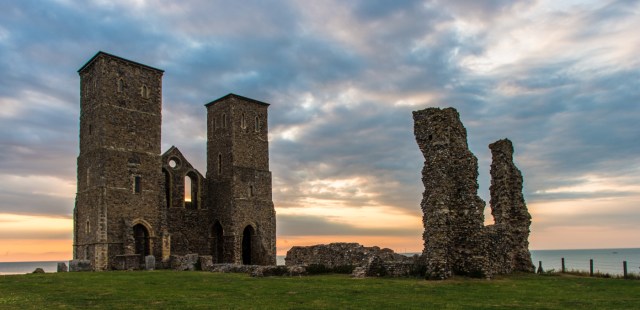
reculver-tower-at-dusk-by-john-walshReculver Tower at dusk by John Walsh

The first records of the Court family at Reculver we have found are the marriages of Stephen Court to Tamazen Kyte and of Mary Court to Edmund Kyte both on 30 Jul 1610.

The 1627 will of Henry Court of Reculver establishes that he, Stephen and Mary Court were brothers and sister.

The Reculver Composite Parish Register starts in 1602 for baptisms and burials and in 1603 for marriages so it is not possible to say whether the Court family was in Reculver before then.

Stephen Court’s will was made on 25 Dec 1656. He wished to be buried in Reculver and he refers to his:

– Late daughter Joan wife of Abraham Chambers and their children: Stephen, Edward, Abraham, Thomasine, Jane, Ann, and Agnes.

– Late daughter Thomasine married to Richard Baxly and their children: Stephen.

– Late daughter Alice wife of Ambrose Stark and they had Thomasine and Mary.

– Son Stephen with daughters Ann and Joan to have house and land in Chislet.

– Son Robert and his sons: Stephen, Robert and James. Robert was to inherit land and messuage in Herne near Blacksole. He refers to Robert’s late wife Ellen and their daughter Thomasine.

The will was proved on 9 Jun 1658

Stephen and Tamazen’s children were baptised at Reculver as follows (ex Findmypast PRs):

Joan 09-Jul 1612
Joan 02-Oct 1615
Thomas 14-Sep 1617
Tamzen 07-Mar 1618
Stephen 26-Nov 1620
Stephen 08-Sep 1622
Mary 14-Dec 1623
Thomas 25-Sep 1625
Elizabeth 20-May 1627
Alice 07-Dec 1628

The burial records show Joan b 1612, Thomas b 1617, Stephen b 1620 and Thomas b 1625 died in infancy. Mary died in 1647, aged 24, before her father wrote his will. Elizabeth is not mentioned in the will and presumably also died young.

The baptism of son Robert referred to in Stephen Court’s will was on 6 Jan 1613 at nearby Herne.

Daughters

Joan married Abraham Chambers at Reculver on 10 June 1639.

Tamzen married Richard Blaxey at Seasalter on 13 Jul 1646. Their son Stephen was baptised at Reculver on 1 Jan 1647. Tamzen was buried at Reculver shortly after, on 15 Feb 1647.

 Alice married Ambrose Stark at St Mary Bredin, Canterbury on 28 June 1653. The two children: Thomasin and Mary were baptised at Herne in 1653 and 1655 respectively.

Sons

Robert Court son of Stephen was baptised at Herne on 6 Jan 1613. It is interesting that Robert’s siblings were all baptised at Reculver but as eldest son Robert might have been baptised where one or both his parents were from.

His father’s will establishes Robert’s wife was Ellen who had died before 1656 and they had daughter Thomasine. Robert and Ellen were married at Reculver on 21 Mar 1642; Robert Court aged 26, yeoman of Reculver to Helen Wraith (also noted as Ellen Wraight) of Barham widow of Nicholas ex FMP East Kent Marriage Index.

Ellen’s previous marriage was:

Wraight, Nicholas, of Adisham, yeom. ” widr., about 24, at his own govt.,” and Ellen Witheat of Hoath, v., about 20, who, her parents being dead, is now in the govt, of John Quilter of S. John’s in Thanet, who consents, as is testified by her brother, John Witheat. At All Saint’s, Cant. John Willett ” aforesaid, bonds. May 10, 1637. ex East Kent Marriage Index.

Daughter Thomasine was baptised at Kingston on 17 Mar 1643. Kingston is very close to Barham where Ellen was living when she married Robert.

Ellen was buried at Reculver on 15 Feb 1645.

Robert’s father’s will shows that by 1656. Robert had sons Stephen, Robert and James.

Stephen was bap at Reculver 8 Sep 1650,

James was also bap at Reculver Sep 1655 son of Robert and Mary. James was buried Reculver 2 Dec 1658 son of Robert and Mary.

Robert’s baptism has not been found but there is evidence of a Robert b 1653:

The marriage record of Robert Court of Herne on 7 Mar 1681/2 shows Robert Court, 29 and Elizabeth Cock, 21 of Herne ex FMP East Kent Marriage Index establishes there was a Robert Court b about 1653. Robert’s father’s will of 1656 shows his sons were to have land and a property in Herne (a few miles for Reculver so there were Court links with Herne). Robert b ca 1653 would fit between Stephen and James. We suggest this is Robert’s son and the one referred to in his grandfather’s will.

 After death of Ellen, Robert must have married Mary between 1645 and 1650. We do not know who Mary was but her will (very kindly transcribed by LucyAnn Curling) fits. There is a son Stephen b 1650 and a daughter Mary that fit and Thomasine the daughter in law could be her stepdaughter. Thomasin’s marriage has not been found. Why is son Robert missing from her will?

Stephen 1622 – 1660

Returning to Stephen’s 1656 will which refers to his son Stephen with daughters Ann and Joan to have house and land in Chislet.

To be buried in the church yard at Reculver and he refers to:

His son Stephen and his two daughters Joan and Ann all under 21.

Ann his ‘now wife’ ie he had be married before.

His brother Robert.

Ann daughter of Stephen junior was baptised at Reculver on 17 Jun 1649. Tamzen dau of Stephen and Ann was bap Reculver 12 Jan 1647and was buried 13 May 1650, daughter of Stephen Court junior.

There appear to be no records for the baptisms of Stephen’s children Joan and Stephen.

Stephen therefore married Ann before 1647 but no marriage record has been found.

1656 Ann Court wife of Stephen died at Reculver no further details.

Stephen died 1660 from his will but there is no burial record. His will refers to his ‘now’ wife Ann that suggests he remarried. There are several possibilities for the marriage:

  1. Ann Court of Reculver, widow of Stephen who married Paul Sackett, yeoman of Margate, widower 14 Feb 1663 at St Mary Northgate ex FMP East Kent Marriage Index. This is unlikely as we will argue below she was the grandaughter of Stephen’s father and therefore the neice of Stephen and such marriage would be precluded. Moreover she was probably a generation younger.
  2. Ann Howson of Hackington widow and Stephen Court of Reculver at St Alphage on 5 May 1657 (also given as 1658) ex FMP East Kent Marriage Index. This would fit well with the death of Stephen’s first wife in 1656. There do not appear to be any children at Reculver for Stephen’s second marriage.

    Who was Ann Court of Reculver, widow of Stephen who married Paul Sackett

    Ann Court of Reculver, widow of Stephen married Paul Sackett, yeoman of Margate, widower 14 Feb 1663 at St Mary Northgate ex FMP East Kent Marriage Index. The following is taken from the Sackett Association website.

‘Paul Sackett instructed his executor to sell all his lands and goods to pay his debts, the residue of his estate to be shared equally between his wife Ann and his children.

Paul’s widow Anne made her will in Buckland next Faversham, on 27 September 1674, naming as beneficiaries her daughters Anne and Elizabeth. She left half of her estate to her son John (presumably her son by her marriage to Stephen Court) and half to her and Paul’s daughters Anne and Elizabeth. She also left £5 each to the children (these would be Susan and Henry) of her late husband Paul.

Will of Anne Sackett of Buckland next Faversham, Kent, 27 September 1674, proved in the Archdeaconry Court, 14 October 1674 (Kent Archives Office, KAO PRC 17-73-350). (Researched by Marion Sackett).  Dated on or about 27 Sep 1674 (Nuncupative) Proved 14 Oct 1674. (Extracted from IGHS Tyler Collection abstracts by Marion Sackett).

Widow; late of Buckland next Faversham, Kent

Son = John Half of my estate plus 2 of my rings Executor

Daus = Anne & Elizabeth Other half of my estate plus 2 rings each

James SAUNDERS £20 Appointed guardian of my children & to use my farm next year for the benefit of my children. To account to Dr. EVE & my brother Abraham CHAMBERS whom I make overseers.

Son & dau in law, children £5 each at 21 of my husband Paul SACKETT

Sister = Jane [? PERCHCOKE] £5 plus linen & woollen

Witnesses :- Henry EVE D.D., Abraham CHAMBERS’

This Ann must have been Ann Chambers as her will shows she had a brother Abraham Chambers. In his will of 1656 Stephen Court refers to his late daughter Joan wife of Abraham Chambers and their children: Stephen, Edward, Abraham, Thomasine, Jane, Ann and Agnes. I think Ann and Abraham were the brother and sister referred to in Ann Sackett’s will.

Unfortunately records for the Chambers family appear to be very limited. There is a baptism for Stephen on 14 April 1639/40 son of Abraham and Joan at Elmstone and a marriage for Stephen son of Abraham at Elmstone on 18 Oct 1661 (no bride given). There is also a burial of Edward son of Abraham at Elmstone on 12 May 1664 but that is all.

The most likely spouse for Ann Chambers is one of her cousins: Stephen son of Stephen, or Stephen son of Robert. Presumably she married one and Susanna Austin who married Stephen Court at Wingham on 2 Dec 1660 (ex England Marriages no details) married the other. Stephen Court’s will written in 1656 provides no clue and Robert Court did not leave a will (however there is a 1661 Inventory) so there is no evidence either way. I shall arbitarily couple Ann Chambers and Stephen son of Stephen and Susanna Austin and Stephen son of Robert, fully accepting it may be necessary to swop the husbands or  perhaps to find completely different ones.

Odds and Ends

Robert Court married Pleasant Christian at Reculver 28 Oct 1714 ex FMP PR. Pleasant Christian was bap 14 Feb 1688 at Hoath daughter if John and Pleasant ex FMP who were married at Chislet on 4 Jul 1671. Pleasant was Pleasant Ewele ex FMP PR

They had Robert 1718 and Pleasant 1717 at Reculver.

Robert was buried Reculver 1720 died 9 Apr 1720
Provisional chart of Courts of Reculver

Descendants_of_Unknown COURT

Posted in Uncategorized | Leave a comment

Who was Thomas Paine’s grandmother?

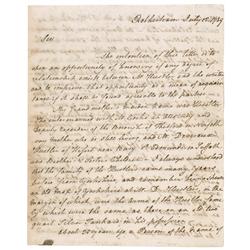
Despite the considerable interest in the life and writings of Thomas Paine (1737 -1809) author of the Age of Reason nothing is known of his maternal grandmother. A letter written and signed by him in 1789 which was sold by auction in June 2010 (http://www.icollector.com/Thomas-Paine_i9511414), provides a vital lead.

Paine Letter

The second paragraph of the letter reads:

My Grandmother’s maiden name was Hustler. She intermarried with Mr. Cocke an Attorney and Deputy recorder of the Borough of Thetford in Norfolk. – my Mother, who is still living, and Mr. Devereux Hustler of Hessett near Bury St. Edmunds, in Suffolk were Brother’s & Sister’s Children – I always understood that the family of the Hustler’s came many years before from Yorkshire.

The letter establishes that Thomas Paine’s grandmother was a Hustler and specifically his mother was a cousin of Devereux Hustler.  It follows that Paine’s maternal grandmother and Devereux Hustler had one set of Hustler grandparents in common and this provides a vital clue to discovering Thomas Paine’s Hustler ancestors.

The wills of Samuel Hustler (1705) and his wife Dorothy (1714) establish they were the parents of Devereux Hustler (born ca 1701) and in turn the will of Thomas Hustler of Bury St Edmunds (1688) establishes that he was the father of Samuel.  Thomas Hustler had three sons: Samuel, Thomas and Charles and two daughters, Elizabeth and Frances one of whom was therefore Thomas Paine’s grandmother. The parish records of St Mary’s Church, Bury St Edmunds provide the baptisms for four of these children (Elizabeth’s baptism has yet to be found) :

Samuel 29 Jul 1675

Thomas 2 Jan 1677

Frances 21 Feb 1679

Charles 26 Apr 1680

There was a fourth son, Henry, baptised on 10 Apr 1682 and buried a few days later on 21 Apr 1682.

Thomas Paine’s mother was Frances Cocke  and she is believed to have been born ca 1697, daughter of Thomas Cocke.  It follows that Thomas’ wife was either Frances Hustler or her sister Elizabeth Hustler, the daughters of Thomas Hustler (1646 – 1688). The answer is provided by a memorial inscription in the church of St Cuthbert, Thetford :

Thomas Cocke, gent. died Feb 19, 1710, aged 42; and Elizabeth his wife, daughter of Thomas Hustler, gent. of Bury St Edmunds, died Dec. 31, 1736, aged 62

Source: The History of the town of Thetford, in the counties of Norfolk and Suffolk, from the earliest accounts to the present time by Thomas Martin, Richard Gough and J Nichols, 1779.

I have recently visited the church and found no sign of the inscription. I suspect it has been covered by the wooden flooring which was probably added since 1779.

A record of Thomas Cocke’s marriage to Elizabeth Hustler has yet to be found.

The marriage licence of Elizabeth Hustler’s parents is recorded in Publications of Harleian Soc, Allegations for Marriage Licences 1669 – 1679 ex Ancestry.co.uk – Thomas Hustler of St Marys Bury St Edmunds , bachelor, about 23 and Elizabeth Dalton of the same,  spinster about 23.  Boyd’s Marriage Index has the marriage at Westley (near Bury St Edmunds) on 7 Oct 1673. This fits with the baptismal records for Samuel, Frances, Charles and Henry Hustler and with the birth of their daughter Elizabeth in 1674.

Thomas Hustler’s wife Elizabeth died in 1683 (she was buried 24 March 1683 at St Marys, Bury St Edmunds).  Thomas must have remarried as his will of 1688 refers to his dear and loving wife Abigail which fits with the marriage of Thomas Hustler of St Edmunds Bury to Abigail Garrat/Garret in 1686 (widow?) at St Dunstan and All Saints, Stepney on 4 Aug 1686 (Source Citation: London Metropolitan Archives, Saint Dunstan and All Saints, Register of marriages, Jan 1631 – Sep 1686, P93/DUN, Item 266).

http://archive.org/stream/marriageregister02step/marriageregister02step_djvu.txt


So Thomas and Elizabeth Hustler’s children lost their mother in 1683 when they were between 3 and 8 years old and their father in 1688 when they were aged between 8 and 13.  So were Thomas Paine’s grandmother Elizabeth and her siblings brought up by their step mother Abigail or by the extended Hustler family?

Thomas Hustler was appointed Undersheriff for Suffolk in 1675 see: Essex Archives Online ref D/DMh O2


Thomas Hustler’s burial record at St Marys Bury St Edmunds on 18 Dec 1688, reads Thomas Hustler, gent, Town Clerk. He was removed from the office of Town Clerk of Bury St Edmunds along with the Deputy Recorder in July 1688 having only been appointed in March that year.  This coincides with the overthrow of King James II and the political upheavals associated with the Glorious Revolution and. It is tempting to think that some of this conflict of ideas filtered down to Thomas Paine.

The Corporation Minute Books of Bury St Edmunds 1652 – 1835 include:

“June 26, 1688.—Gentlemen, Some time since I received a letter from you very full of duty and loyalty to our King, which you desired I would communicate to his Majesty from your Corporation. I was extremely glad of so good an opportunity of serving a body of men I always much esteemed and ever had inclinations to be kind to. Your King was pleased to read your letter himself, seemed much satisfied to find such an alteration in Bury, commanded me to thank you for it, and to assure you from him that as he expects you will make good your word to him, so likewise his Majesty will most inviolably keep whatever he has promised in his Declaration.

“After having obeyed his Majesty’s commands, give me leave in my own particular to return my sincere acknowledgments for your kind expressions to me. If ever it be in my power to deserve it from you, assure yourselves I shall do it with all the readiness imaginable, and not more than you ought to expect from one that is so much, Gentlemen, your affectionate humble servant, “Dover.”

—, 19 July.—The deputy-recorder, John Sotheby, and the townclerk, Thomas Hustler, removed by order from the King and Council of 6 July, and Edmund Coleman and Jonathan Perry admitted by order of 7 July, without taking any oaths but those for the execution of their offices.

—, 10 Aug.—Edmund Coleman sworn in as Recorder with all the oaths according to the statutes, and a common-council man admitted in the same manner, taking the oaths of allegiance and supremacy and the oath mentioned in stat. 13 Car. II. cap. 1.

—, 23 Aug.—Two aldermen sworn in as assistant justices, taking all the statutory oaths.

—, 18 Sept.—Order from the Privy Council for removing two aldermen (Thomas Burrough and Thomas Hustler, of whom the latter had been appointed on 16 March) and four common-council-men (of whom two had been appointed on 14 May) and appointing certain others in their places without any oaths but that for the execution of their office.

—, 12 Oct.—Two addresses to the King submitted for consideration, of which one was passed by a majority, to be presented by some of the members with all possible expedition. It is ordered to be entered in the book, but the page which follows is left blank.

—, 22 Oct.—The King’s proclamation for restoring corporations is read, and entered at length; and the charter of surrender made to Charles II. not being enrolled in any of the courts, and all persons appointed since by any patent or grant being dismissed by the proclamation, Martin Spencely, gent., is elected alderman under the old charter, and all the surviving members of the old Corporation are restored and the places vacant by death filled up.

—, 12 Jan.—Sir Rob. Davers, bart., and Sir Tho. Hervey, knt., elected members for the convention-parliament.

—, 19, 24 Jan.—John Covell elected town-clerk; he takes the oath for due execution of his office, and signs the statutory declaration, but the Recorder refuses to administer the oaths of allegiance and supremacy “in regard King James had left the realm, and it was conceived those oaths would be abrogated and new oaths appointed in their stead.

1689 [–90], 6 March.—Sir Rob. Davers, bart., and Henry Goldwell, esq., elected for parliament.

—, 17 March.—The town music discharged from future service in attending the Corporation, nemine contradicente.

Thomas Hustler’s father, Samuel Hustler of Bury St Edmunds, was also involved in the local political scene and was appointed Alderman of Bury St Edmunds in 1665 at the time of the Great Plague.

1674 Samuel Hustler Borough Magistrate *

1675 Samuel Hustler Chief Burgess *

see http://www.stedmundsburychronicle.co.uk/Chronicle/1539-1699.htm

1665 The Great Plague broke out in London, and soon spread. Many villages around Bury were stricken. People leaving London who were already infected spread the disease to friends or relatives in the country.

One of the worst hit local places for plague was Needham Market. Chains were set up at either end of Needham and the inhabitants isolated themselves from the outside world. Food was delivered to the barriers in exchange for money left there by the inhabitants. Local tradition states that the dead were buried in two local fields. Normally the dead of Needham would be buried and registered at Barking, but during the plague this could not happen.

This isolation seems to have been fairly successful. Nearby Stowmarket escaped entirely, and there must have been an acceptance by Needham people that they would not try to leave their own village despite the death toll. Ipswich also suffered from the Plague.

At Bury emergency measures were also taken in the town. Thomas Bull, owner of the Angel, and a common carrier, was forbidden to take his usual waggon runs to London. A watch was posted at each town gate to keep out travellers, and it seems that these measures actually worked.

Despite the effective measures put in place in Bury against infection, in this plague year three Aldermen were elected in Bury one after the other, as each in turn refused to accept the office, because they would be tied to the town if plague should arrive. Fines of £35 and £50 were imposed for their refusal to accept, and only the fourth elected person, Samuel Hustler, accepted the office.

In Bury, the Guildhall Feoffees built the Pest House as an isolation hospital in Sexton’s Meadows. They were not needed in 1665, as they had succeeded in keeping plague out of Bury. After this time the Plague seems to have died down. But by 1677 another deadly disease, the Smallpox, would terrify the town.

Samuel Hustler was buried at St Marys, Bury St Edmunds on 23 Dec 1677 –  Mr Samuel Hustler, a principal burgess. There is a strong possibility that he was a victim of smallpox. In his will of 1677 he refers to “my grandchildren, sons and daughter of my son Thomas: Samuel, Thomas and Elizabeth” and gifts them £50 apiece. His granddaughter, Frances, and grandson, Charles, were born 2 – 3  years after his death and as such were not included.

This establishes that Paine had a least three generations of Hustlers associated with Bury St Edmunds who were deeply involved in local politics.

Cocke Family

Thomas Paine’s maternal grandfather was Thomas Cocke who was appointed Town Clerk of Thetford in 1701 (source John Keane). The memorial inscription at St Cuthberts, Thetford establishes new information i.e. that Thomas Cocke died in 1710, aged 42 ( born 1668).  He was therefore Thomas Cocke baptised at St Mary, Thetford, 20 Sep 1668, son of John and Margaret Cocke. There was another son, John Cocke also baptised at St Marys 18 Mar 1669.  John Cocke, the father,  married Margaret Snelling (widow) at St Peter and Cuthbert, Thetford 5 Nov 1667. Margaret had previously married Robert Snelling. The Snellings had several times been mayor of Thetford (John 1599, 1603 Robert 1613, 1617, John 1624, Robert 1627, John 1634, Robert 1636, Thomas 1642).

Several authors have speculated that Thomas Cocke was descended from John Cocke who was Deputy Recorder of Thetford 1629 and this appears very likely. The will of John Cock, Gentleman of Thetford, Norfolk, 17 February 1643, refers to his wife Margaret, his messuage and tenement in Thetford and Watton, his daughter Anne, his oldest son Robert and his son John who was to receive all the books in his study when 21 intending him to become an Attorney

The son John referred to in the will could very well be the father of Thomas Cocke or perhaps his grandfather.

July 2014

Posted in Uncategorized | Tagged , , | 1 Comment