
Despite the interest in the life and writings of Thomas Paine (1737 -1809) as far as I can discover nothing is known of his maternal grandmother. A letter written and signed by him in 1789 which was sold by auction in June 2010 (http://www.icollector.com/Thomas-Paine_i9511414), provides a vital lead.
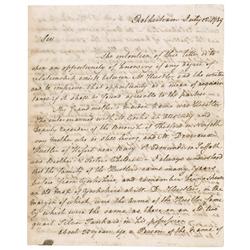
The second paragraph of the letter reads: My Grandmother’s maiden name was Hustler. She intermarried with Mr. Cocke an Attorney and Deputy recorder of the Borough of Thetford in Norfolk. – my Mother, who is still living, and Mr. Devereux Hustler of Hessett near Bury St. Edmunds, in Suffolk were Brother’s & Sister’s Children – I always understood that the family of the Hustler’s came many years before from Yorkshire.
The wills of Samuel Hustler (1705) and his wife Dorothy (1714) establish that they were the parents of Devereux (born ca 1701). So it follows that Samuel Hustler had a sister who was Thomas Paine’s grandmother. The will of Thomas Hustler of Bury St Edmunds (1688) confirms that he is the father of Samuel and that he also had two sons, Charles and Thomas, and two daughters, Elizabeth and Frances. The parish records of St Mary’s Church, Bury St Edmunds provide the baptisms of the children, excluding Elizabeth whose baptism has yet to be found:
Samuel 29 Jul 1675
Thomas 2 Jan 1677
Frances 21 Feb 1679
Charles 26 Apr 1680
There was a further son, Henry, baptised on 10 Apr 1682 and buried a few days later on 21 Apr 1682. One of the daughters, either Elizabeth or Frances, was therefore Thomas Paine’s grandmother.
We know Thomas Hustler had links with Thetford as the Norfolk Record Office have a document titled Exemplification of common recovery suffered re two messuages and gardens in Thetford, John Jacobb-demandant against Thomas Hustler, gent. dated 6 Feb 1686, Catalogue ref MC 2945/16, 1026X1
The baptismal records for Samuel, Frances, Charles and Henry refer to the mother as Elizabeth. Clearly then, she is mother of them all. She died in 1683 (buried 24 March at St Marys). There is a suggestion that she was Elizabeth Maxey (see http://makeseye.wordpress.com/1600-2/). Thomas must have remarried as he refers to his dear and loving wife Abigail in his will. Thomas Hustler died in 1688 and his burial record at St Marys on 18 Dec 1688, reads Thomas Hustler, gent, Town Clerk. This is interesting as Thomas Paine’s grandfather, Thomas Cocke was Attorney and Deputy Recorder of Thetford. Thetford is 12 miles north of Bury St Edmunds and it is easy to imagine how two families involved in local government met and intermarried.
It is also significant that Thomas Hustler might have been in conflict with the powers-to-be just before his death. He was removed from the office of Town Clerk along with the Deputy Recorder in 1688. The time exactly coincides with political upheavals associated with the Glorious Revolution. It is tempting to think that some of this conflict of ideas filtered down to Thomas Paine. The Corporation Minute Books of Bury St Edmunds 1652 – 1835 include:
“June 26, 1688.—Gentlemen, Some time since I received a letter from you very full of duty and loyalty to our King, which you desired I would communicate to his Majesty from your Corporation. I was extremely glad of so good an opportunity of serving a body of men I always much esteemed and ever had inclinations to be kind to. Your King was pleased to read your letter himself, seemed much satisfied to find such an alteration in Bury, commanded me to thank you for it, and to assure you from him that as he expects you will make good your word to him, so likewise his Majesty will most inviolably keep whatever he has promised in his Declaration.
“After having obeyed his Majesty’s commands, give me leave in my own particular to return my sincere acknowledgments for your kind expressions to me. If ever it be in my power to deserve it from you, assure yourselves I shall do it with all the readiness imaginable, and not more than you ought to expect from one that is so much, Gentlemen, your affectionate humble servant,
—, 19 July.—The deputy-recorder, John Sotheby, and the townclerk, Thomas Hustler, removed by order from the King and Council of 6 July, and Edmund Coleman and Jonathan Perry admitted by order of 7 July, without taking any oaths but those for the execution of their offices.
—, 10 Aug.—Edmund Coleman sworn in as Recorder with all the oaths according to the statutes, and a common-council man admitted in the same manner, taking the oaths of allegiance and supremacy and the oath mentioned in stat. 13 Car. II. cap. 1.
—, 23 Aug.—Two aldermen sworn in as assistant justices, taking all the statutory oaths.
—, 18 Sept.—Order from the Privy Council for removing two aldermen (Thomas Burrough and Thomas Hustler, of whom the latter had been appointed on 16 March) and four common-council-men (of whom two had been appointed on 14 May) and appointing certain others in their places without any oaths but that for the execution of their office.
—, 12 Oct.—Two addresses to the King submitted for consideration, of which one was passed by a majority, to be presented by some of the members with all possible expedition. It is ordered to be entered in the book, but the page which follows is left blank.
—, 22 Oct.—The King’s proclamation for restoring corporations is read, and entered at length; and the charter of surrender made to Charles II. not being enrolled in any of the courts, and all persons appointed since by any patent or grant being dismissed by the proclamation, Martin Spencely, gent., is elected alderman under the old charter, and all the surviving members of the old Corporation are restored and the places vacant by death filled up.
—, 12 Jan.—Sir Rob. Davers, bart., and Sir Tho. Hervey, knt., elected members for the convention-parliament.
—, 19, 24 Jan.—John Covell elected town-clerk; he takes the oath for due execution of his office, and signs the statutory declaration, but the Recorder refuses to administer the oaths of allegiance and supremacy “in regard King James had left the realm, and it was conceived those oaths would be abrogated and new oaths appointed in their stead.
1689 [–90], 6 March.—Sir Rob. Davers, bart., and Henry Goldwell, esq., elected for parliament.
—, 17 March.—The town music discharged from future service in attending the Corporation, nemine contradicente.
Thomas Hustler’s father, Samuel Hustler of Bury St Edmunds was also involved in the local political scene. He was appointed Undersheriff for Suffolk in 1675 see:
http://seax.essexcc.gov.uk/Result_Details.aspx?DocID=135268
Samuel had been appointed Alderman of Bury St Edmunds in 1665 at the time of the Great Plague
see http://www.stedmundsburychronicle.co.uk/Chronicle/1539-1699.htm
| 1665 The Great Plague broke out in London, and soon spread. Many villages around Bury were stricken. People leaving London who were already infected spread the disease to friends or relatives in the country.One of the worst hit local places for plague was Needham Market. Chains were set up at either end of Needham and the inhabitants isolated themselves from the outside world. Food was delivered to the barriers in exchange for money left there by the inhabitants. Local tradition states that the dead were buried in two local fields. Normally the dead of Needham would be buried and registered at Barking, but during the plague this could not happen.This isolation seems to have been fairly successful. Nearby Stowmarket escaped entirely, and there must have been an acceptance by Needham people that they would not try to leave their own village despite the death toll. Ipswich also suffered from the Plague.At Bury emergency measures were also taken in the town. Thomas Bull, owner of the Angel, and a common carrier, was forbidden to take his usual waggon runs to London. A watch was posted at each town gate to keep out travellers, and it seems that these measures actually worked.Despite the effective measures put in place in Bury against infection, in this plague year three Aldermen were elected in Bury one after the other, as each in turn refused to accept the office, because they would be tied to the town if plague should arrive. Fines of £35 and £50 were imposed for their refusal to accept, and only the fourth elected person, Samuel Hustler, accepted the office.In Bury, the Guildhall Feoffees built the Pest House as an isolation hospital in Sexton’s Meadows. They were not needed in 1665, as they had succeeded in keeping plague out of Bury. After this time the Plague seems to have died down. But by 1677 another deadly disease, the Smallpox, would terrify the town. |
The smallpox outbreak may account for Samuel’s death in 1677. He was buried at St Marys on 23 Dec 1677 – Mr Samuel Hustler, a principal burgess. In his will of 1677 he refers to “my grandchildren, sons and daughter of my son Thomas: Samuel, Thomas and Elizabeth” and gifts them £50 apiece. His granddaughter, Frances, and grandson, Charles, were born 2-3 years after his death and as such were not included.
My conclusion is that the Hustler grandmother referred to by Thomas Paine is Frances (or possibly Elizabeth) Hustler who was the daughter of Thomas Hustler and granddaughter of Samuel Hustler both of whom were very actively involved in local politics. It is easy to image this familial taste for political affairs having had some influence on Thomas Paine.
 Jottings on my Family History
Thomas Coke married Elizabeth Hustler at Euston, Suffolk, on 17th June 1734. Their daughter Frances (Established church) married Joseph Pain, a quaker. He was booted out for marrying outside of the sect.